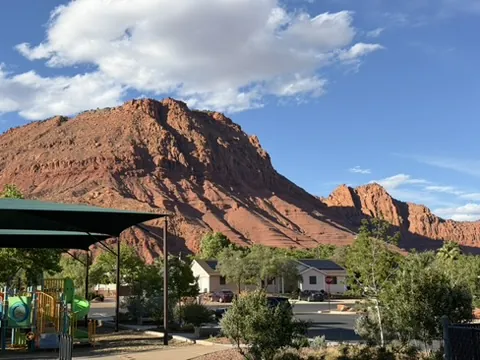
This month marks 100 years since a small farming settlement west of Santa Clara dedicated its first chapel, in November 1926. That same occasion is when the town we now call Ivins got its name. Here is how the “Santa Clara Bench” became Ivins, Utah.
Water first: the canal that opened the bench
Like several other Washington County towns, Ivins couldn’t be settled until someone brought water to the land. According to the Utah Division of Archives and Records Service, a group of men from Santa Clara worked together to build a canal to the bench, and the project was finished in 1918. The City of Ivins’ own history says the water came from the Santa Clara River, and that The Church of Jesus Christ of Latter-day Saints bought a considerable amount of land and water stock when the canal project began. The Church paid in cash, which helped buy cement, flume materials and other supplies.
The first families on the Santa Clara Bench
The State Archives records that the first family moved to the area in 1922. The City and the Ivins Historical Society both describe the settlement years as 1922 to 1926, with settlers who were descendants of Swiss immigrants. The first survey of the town site was even called the Santa Clara Bench Survey.
Life was built around farming. Families raised crops on the newly watered land, and some grazed cattle on Pine Valley Mountain and in the Pinto area. Drinking water came from a spring then known as the Snow Canyon Spring. Today it’s called Johnson Arch Spring, inside what is now Snow Canyon State Park.
November 1926: a chapel and a new name
Anthony W. Ivins, a Church leader who had first come to the area to look into the canal project and sent back a favorable report, returned to dedicate the settlers’ new chapel in November 1926. By then he was serving as second counselor to Church President Heber J. Grant. Settler Leo Reber later recalled Ivins telling the congregation that he had come to Santa Clara as a boy with his father, who was helping bring the original Swiss company of settlers to the region.
At that time the settlers wanted a better name than “Santa Clara Bench.” Several names were suggested, and the one chosen came from Edward H. Snow, president of the St. George Stake, who proposed naming the town after Anthony W. Ivins. Both the City and the Historical Society credit Ivins’ earlier missionary work with the region’s Native American communities as the reason he was so well known locally. When asked about the idea, he reportedly answered that it was fine “as long as they spell it Ivins, instead of Ivens.”
Ivins gave one hundred dollars in cash toward the chapel and promised the town a bell. He kept that promise: according to the City, the bell still hangs in the belfry of the old church.
From town to city
The State Archives lists Ivins as incorporated on August 5, 1935. Growth stayed slow for decades. The City’s draft General Plan history notes the town grew very slowly until the early 1980s, when Kayenta began. On August 11, 1998, Utah Governor Michael O. Leavitt signed a proclamation making Ivins a city of the third class, based on a 1996 Census Bureau estimate of 3,149 residents.
Seeing that history today
The farm fields have mostly given way to neighborhoods, but the story of water, hard work and neighbors pulling together still shapes Ivins. If you’d like to know more about living here, take a look at Ivins homes for sale, explore our communities, read the Moving to Southern Utah guide, or head back to the OwnUtah.com homepage.
More from the OwnUtah Journal
- Happenings in Kayenta: October 29 to November 4, 2026
- Follow the Flag in Snow Canyon for Veterans Day
- Ivins city meetings archive
Sources
- City of Ivins, FY2025 budget document, community history section
- Utah Division of Archives and Records Service, Ivins (Utah) agency history
- Ivins Historical Society, History of Ivins City
- City of Ivins, General Plan draft history chapter (May 2024)
- State of Utah, Governor’s proclamation of August 11, 1998
- Utah State Parks, Snow Canyon State Park
Thanks for reading!
Robert Bolar
REALTOR®, Summit Sotheby’s International Realty
801-737-3333 · Robert@OwnUtah.com