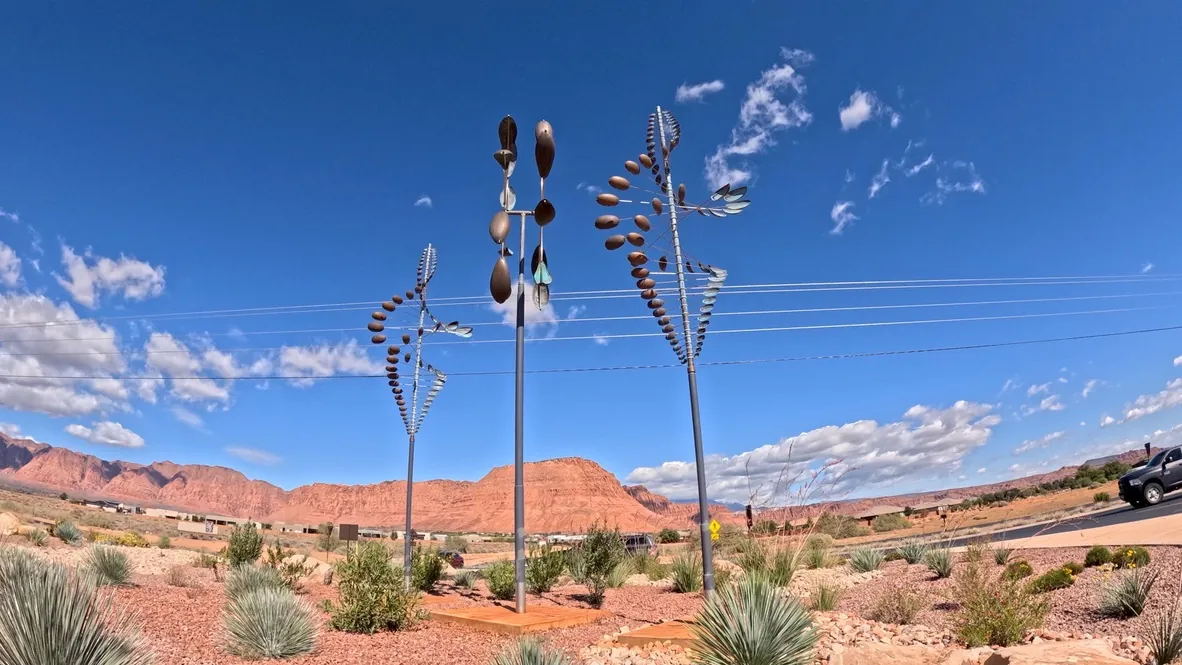
Thanksgiving week is a fitting time to tell this story. Kayenta, the low, earth-colored neighborhood tucked against the red cliffs on the west side of Ivins, traces its beginning to a Thanksgiving Day more than 50 years ago, and this year the community is marking its 50th anniversary. Here is how an empty ranch below Red Mountain became one of the most distinctive places to live in Southern Utah.
A Thanksgiving Day on Old Highway 91
According to a Utah Life magazine profile of Kayenta, founder Terry Marten was driving west on Old Highway 91 near Ivins on Thanksgiving Day 1971 when his truck hit an icy dip, left the road and rolled onto its side. Marten, who regularly drove that road on his way to Brian Head, where he was building housing in the ski resort’s early days, climbed out unhurt. As he scrambled up the bank, the sun broke through. “I looked at Red Mountain and pinched myself,” he told the magazine. While he waited for help, he decided that someday he would build a community on the land in front of the mountain.
Buying the ranch
The land was not for sale at first. When it was, Marten and a few partners bought it, though the sources give slightly different details. In his own account on Kayenta’s website, Marten writes that a few of them purchased a 1,300-acre ranch west of St. George, out by Shivwits, in 1975, and a 2013 Las Vegas Review-Journal column gives the same year and acreage. The Utah Life profile says he bought nearly 2,000 acres in 1976, and in a January 2026 Kayenta Connection article, his son Matt Marten dates the purchase of the first parcel to 1976, which is why Kayenta is celebrating 50 years in 2026.
Either way, the land was a long way from a subdivision. Marten recalls a big, open ranch with fences, a broken line of cottonwoods along an open irrigation ditch that ran toward the fields of Ivins, and a few of Joy Peterson’s cows. He notes that the Gubler homestead had been moved into Ivins about 50 years earlier, and he remembers locals joking that the newcomers did not have even one share of irrigation water on the ditch. Matt Marten writes that Ivins was home to only about 400 people at the time, and both Martens put St. George at roughly 10,000 residents.
The “Kayenta Concept”
Before anything was built, the partners had to work out a water source and bring power and telephone lines three or four miles to the site. While they did, they sketched what the ranch might become. Marten writes that the “Kayenta Concept,” written in 1979, began as a rough master plan showing major roads, open space and areas for homes, and he admits their timing was “about a decade premature.”
The ideas stuck. The Kayenta HOA’s summary of the Kayenta Concept, drawn from its Architectural Control Committee handbook, lists four core tenets: low-profile buildings that protect views, colors and materials that blend into the natural setting, subdued lighting to protect the dark night sky, and preservation of the natural desert landscape. Utah Life adds that only native plants may be used, that 75 percent of each property must stay in its natural state, and that Kayenta has no streetlights.
Building slowly, on purpose
Sources again differ a little on the first homes. The Review-Journal says the first phase began in 1982, and Utah Life says Marten built the first home in 1982 and just one home in each of the next two years. The HOA’s history says the community has grown steadily “since the first home was built by Terry Marten in 1984.”
Not everyone understood the idea at first. Matt Marten told the Review-Journal that local farmers and ranchers were puzzled, because they valued flat land, not the washes, gullies and gorges Kayenta was built around. Building picked up in the 1990s, Utah Life reports, and Terry Marten brought in Matt, an architect, to custom-design homes to fit each lot. Matt told the magazine that homeowners choose from six exterior colors, “and they’re all brown.” By 2013, he told the Review-Journal, Kayenta Development controlled about 2,200 acres and planned to keep developing over decades.
An art village grows up
Art arrived early. Utah Life says sculptor Lyman Whitaker came up with his signature copper wind sculptures in Kayenta in the 1980s, when his studio was next to Marten’s office. The magazine credits Xetava Gardens Cafe, built in 1999 by Dan Pettegrew, with starting what became the Kayenta Art Village; its name combines “xeriscape” and “lava.” Galleries followed, many of them in converted RV garages, and Datura Gallery was the first to open.
The Art in Kayenta festival had reached its 14th year by October 2013, according to St. George News, which also reported that the nonprofit Kayenta Arts Foundation was incorporated in February 2011. That same year, St. George News reported that Kayenta was adding a fire station for the Ivins Fire Department inside the Coyote Gulch Art Village.
The Center for the Arts at Kayenta
The foundation broke ground on a performing arts center on May 31, 2013, with Ivins Mayor Chris Hart and the City Council on hand, St. George News reported. Kayenta Development donated the land. The building was first expected to open in 2014, but it was paid for mostly with donations and fundraising events, and construction took longer. St. George News reported in January 2017 that construction was complete, and the foundation opened the doors to the public later that month. Foundation chair Judith Kapuscinski said the largest donor was Terry Marten, who also helped design the building with Matt.
Kayenta at 50
Utah Life counted nearly 600 homes around the art village and noted that only about a quarter of Kayenta’s land had been developed, a deliberately slow pace. Matt Marten wrote in January 2026 that Kayenta began as an experiment, and that its guiding principle of living gently on the earth still guides it half a century later. For Ivins, a quiet ranch below Red Mountain became home to galleries, a theater and neighborhoods such as Kayenta, Shonto Point and Taviawk.
If you’d like to live below Red Mountain, take a look at Kayenta homes for sale and Ivins homes for sale, browse every Ivins neighborhood on our Communities page, or head back to the OwnUtah.com homepage.
More from the OwnUtah Journal
- Ivins History: How the Santa Clara Bench Became Ivins
- Ivins History: How Snow Canyon Became a State Park
- Ivins History: How Tuacahn Came to Be
- Happenings in Kayenta, Week of November 19, 2026
Sources
- Utah Life Magazine, Matt Masich, “Kayenta”
- Kayenta Development, “The Story” by Terry Marten (kayentautah.com)
- Kayenta Homes & Properties, Kayenta Connection, January 2026: “Kayenta 50 Years 1976–2026” by Matt Marten
- Kayenta HOA, “How the Kayenta Concept Defines the Unique Qualities of Our Community” (PDF)
- Las Vegas Review-Journal, Jane Ann Morrison, “Kayenta Looks Like Red Rock With Homes” (October 7, 2013)
- St. George News, “Kayenta Expands With New Arts Center, Fire Station” (July 19, 2013)
- St. George News, “Public Invited to Kayenta Center for the Arts Groundbreaking” (2013)
- St. George News, “Kayenta Arts Foundation Hosts Open House for New Center for the Arts” (January 23, 2017)
- St. George News via Cedar City News, “New Center for the Arts Provides Needed Space for Performance, Visual Art” (January 28, 2017)
Thanks for reading!
Robert Bolar
REALTOR®, Summit Sotheby’s International Realty
801-737-3333 · Robert@OwnUtah.com